Sunday, November 17, 2013

Honesty is such a lonely word, Everyone is so untrue, Honesty is hardly ever heard…


 I don’t think we’ve mentioned it in the blog, but we have a new driver. The story of that and another situation I’ve had to deal with at work are the subjects of my part of this week’s blog.

First Mehndi. A couple of weeks ago Mehndi told me his father was “dead” (I assumed he meant very ill) and he needed to take a week off to go to be with him in the hospital. Work got a temporary driver for the week and we were off and running, err driving. Shelendar was like the opposite of Mehndi. Where Mehndi was aggressive, even wild sometimes, Shelendar was VERY cautious and careful in traffic. Where Mehndi was talkative, Shelendar hardly said anything. Where Mehndi knew every location in Delhi and three or four ways to get to and from each, Shelendar barely knew his way around. Despite all of that, it was kind of relaxing.

Well the first day, Shelendar took me to a place Mehndi had taken me dozens of times. I should tell you one thing: when there’s a parking fee, the driver may pay it originally, but he then is reimbursed for those fees. So, I said to Shelendar, “What was parking?” He told me 10 rupees.  I didn’t believe I had heard correctly so I asked again and got the same answer. I was surprised because Mehndi had always said the parking was 80 rupees there. The next day was Saturday and we had Shelendar take us to a shopping area. So, when we were through, I asked, “What was parking?” This time Shelendar said 20 rupees. This is compared to the 150 Mehndi would usually have said. Later that day Shelendar took us to the mall. Here the parking was 50 rupees compared to the 350 rupees that Mehndi would have said.

The next Monday at work, I asked, “what does parking usually cost?” I was told that except at the mall, where it might be 50 rupees, normally it would be 10 to 20 rupees. “Would parking ever be as much as 350?” I asked. No that would be impossible. So, anyhoo, I explained the pattern Mehndi had been following for the past five months. It was clear that Mehndi was overcharging me significantly for parking at every turn. Additionally, often I would not have the exact amount Mehndi would specify, so I would give him 100 rupees. I rarely got the difference repaid. Also, I would periodically buy Mehndi lunch or dinner if we were out for a long time. It became clear that Mehndi was systematically cheating me by overcharging. This discovery led to a review of the reports Mehndi had been turning in. It turns out he had also been padding his hours. We decided that based on that he would have to go. Now to find a replacement.

Shelendar was not a choice. A: see the above description about Shelendar’s driving and demeanor; 2: Shelendar lives a long way off and the hours he was willing to work were restricted; and III: he wanted too much money. What to do, what to do?

We had determined we were actually going to get two drivers. One to work Sundays and one to work the other six days. I had suggested the name of a member of our branch who was a driver, who had told me he couldn’t work full time but would like to work weekends if that opportunity ever occurred. So Robinson (his name is Robinson Singh) interviewed for the part-time position and wowed everyone. In that process, he found out we were looking for a full time driver too. Despite the fact he had only wanted part-time, when he found out he would be our driver he said he wanted to work full time and be our driver. So now he is.

Now for the other situation. Through a combination of events, we came to know that one of my directors, a manager, and our handyman were involved in a long standing fraud involving skimming money from contract work, getting kickbacks from vendors, and stealing and selling surplus property. Friday I let them all go. That will put us in a bind for a while as we try to keep things operating. I expect with them out of the way, we will find more ways they have been skimming money from the organization.

In talking to Charu, our CEO about the situation, she had an interesting perspective. She said, In India you always assume there will be some amount of kickbacks, some amount of stealing, and graft. You just think of that as part of the cost of doing business. However, when it gets to the point this had; when the corruption was blatant, wide spread, and there wasn’t even much attempt to cover it anymore, then you have to take action. I know I am just a naive country boy. I know there is graft and fraud in the States as well. But the degree to which corruption here has invaded every aspect of the economy, and the degree of complacency that exists amazes me. It does seem, “…Everyone is untrue, Honesty is hardly ever heard….”

Here is someone’s who integrity is above reproach. Rae, it’s all yours.

Hi all,

Our new driver has been a driver in Delhi for about 20 years, plus he grew up here, so he really does know his way around. He also speaks English a lot better than either of our other 2 drivers which from my stand point is a great advantage. 

If you are on Facebook with me you will have heard a bit about this experience, and I apologize for repeating myself.  On Saturday Phil and I had gathered a couple of pair of shoes that were in need of repair in hopes that Robinson would know of a repair shop.  We asked Robinson if he knew of a shoe repair and he told us he did.  Said there were a couple across the road in New Friends Colony.  He drove down one road slowly looking for what I assumed would be one of the little stalls that are all over.  He then turned onto another road and did the same.  After a short distance he pulled over to the side of the road and said we “are here”.  All I could see were 4 or 5 men sitting on their haunches on the sidewalk.  There was no sign, no table, and from what I could see no supplies.  Robinson got out of the car with Phil and the shoes, had a conversation and then got back in the car with no shoes.  Phil’s shoes needed new heels, and I had a pair of sandals that needed new soles.  I had taken my sandals to a repair shop in the US and was told that they weren’t worth fixing because new soles would be around $50, more than my sandals were worth.  I loved those sandals and so didn’t throw them away because I was going to wear them a bit longer if I could.  After Phil got back in the car he told me that the costs was 300 rupees, (less than $5) and they would be ready in about 4 hours.  We drove away with me wondering if we would ever see our shoes again and also wondering how they were going to accomplish the task with so few tools or supplies.  When we got our shoes back just over 4 hours later, they looked great, and I was shocked and thrilled.  

I tried to quickly take a couple of pictures from inside the car, so they are not great pictures, but hopefully you will get the Idea.  The picture of the back of Phil is him talking to the shoe repair guys.
Just down the sidewalk I took a couple of other pictures.  They are examples of some of the other things or services that you can find on the sidewalks.  One picture is a board of locks.  I’m wondering if these were locksmiths along with vendors.  The other picture is something I’ve noticed all around.  It is a chair facing a fence with a mirror propped up on the fence.  Maybe you’ve guessed already, but this is where you would go for a haircut or a shave, or even both.  I’ve also seen ironing, food vendors cooking on a hot plate, people selling tea or tobacco, and while I haven’t seen it yet, I’ve heard you can get dental work done, (at least a tooth pulled).  I’m going to try to pay better attention in the future, because quite honestly a lot of these things have gone totally unnoticed by me.  Maybe I’ll have others to add to the list in the future.  Hope you can interpret the pictures and find them interesting.  There are so many fascinating things that I’m not able to capture from a moving car.      


Namaste.

Monday, November 11, 2013

Look at this photograph…

First of all, sorry for the delay in posting. I am sure there were scores of you who have been waiting with baited breath for our latest blog entry. There were some challenges on the home front this weekend that absorbed our time and energy. First, our renter decided to go off the tracks and is making noises about breaking her lease. More importantly, our youngest grandson Lincoln (just over one) pulled a pot of boiling ramen down on himself. At least two nights in the hospital. Not only did he have burns over his body and arms but he had an allergic reaction to the burns, or something and went into anaphylactic shock. Not to belabour the issue but there are times that being half way around the world is hard. 

As a consequence of the above, we taking the opportunities to mostly post pictures this week with minimal dialog. For those of you who are tired of our ramblings already, you are welcome.

First, a couple of weeks ago we posted about the Halloween activity at the Branch. Rae and I were too busy to take any pictures but here are a few that were sent to us.


The Branch members thought our devil and angel costumes were the best.

Last Tuesday was the last day of Diwali and the campus was closed. Also, the weather was nice so we decided to finally do some touristy things. First stop was Dilli Haat, which is a market at which there are handicrafts, textiles, and art work available from all over India. It is a little like the seasonal market we mentioned a couple of weeks ago but much bigger and more commercialized. Despite that we were able to find a few things that caught our eye. Got to do our part for the Indian economy, you know? Here are a few pictures. The first one is my favorite. Isn't Rae cute?


Our next stop was to an area Rae had gone to before, Hauz Khas. Rae had been there a week or two ago and we posted a couple of pictures before. Not to be too repetitive of that previous post, but the basics are this. The Sultan of Siri (precursor of Delhi) built a large lake to supply the water needs of the city. Adjacent to that lake, over time a mosque, school, and tombs were constructed. Hauz Khas, which means royal lake, is a neighborhood that has developed around the ruins of those buildings and lake. In addition to the lake and ruins, there are dozens of upscale restaurants and boutiques. A fun way to spend the afternoon.


Last couple of random things. Initially, our temporary driver dropped us off at the wrong place and we had to walk to find the ruins. On the way we made our way through a very attractive park and took a couple of pictures of it. Also, we thought you might enjoy a picture of a sidewalk we passed and a neighborhood electrical hookup. Neither are typical, per se. Not really atypical either, however.


One final picture. We think this is classic and joins the "Mind the gap" sign from London, and the "No Smorking" sign from Tokyo.


Namaste.

Sunday, November 3, 2013

In the light, Everybody needs the light....

The episode of the blog is going to cover two holidays. I will start talking about the epitome of Indian holidays and then Rae will report on an American holiday that we helped a little to bring to India this past week.

Happy Diwali (pronounced deevahlee), everyone. Our posts have covered the topic of Indian festivals in general and the details of some in the past. Today is the heart of the most important festival across India: Diwali. As with most festivals in India, Diwali has roots firmly in Hindu religion and tradition but it has morphed overtime so that even non-religious celebrate it. In many ways it is analogous to Christmas. It clearly had religious origins, but now it has a life outside the religious meaning as an opportunity for giving gifts, celebrating, and parties. Actually the parallels extend to gifts. Just as with Christmas where presents have morphed from simple gifts and fruit and candy to the expensive and expansive, the same pattern exists with Diwali. Originally, dried fruits and nuts were the gifts that were exchanged. These items still play a significant role but now their role is more like candy canes at Christmas: an iconic image but if that is all that was given or exchanged there would be rampant disappointment.

Diwali is actually a contraction of Deepavali which means festival of lights. The celebrations cover five days but Diwali proper falls on the third day of the five. As noted above, parties, gifts, and lighting candles are important parts of the celebration. Traditionally the candles are made of small clay dishes filled with ghee (clarified butter) with cotton wicks. Those are still very common but now one also finds electric lights hung on buildings or strung around rooms. Historically, Diwali was the beginning of the new year and as such some of the religious ceremonies had to do with that. Particularly, importunes to Ganesh, who as I have mentioned before is the God of new ventures (in part) and Lakshmi, the Goddess of prosperity. These ceremonies, called pujas, are religious ceremonies in which offerings such as fruits, flowers, oil, water, essence, and other items are offered to a god or goddess. These offerings are usually accompanied with chanted or sung prayers. Such pujas can be done in temples, in businesses or in homes.

Relative to people inviting Lakshmi, a friend of mine told me a Hindi urban legend. As Lakshmi is the Goddess of prosperity, it used to be common for people to leave their doors open on Diwali to invite her into their homes and lives. However, thieves knew that people would leave their doors open so they started robbing all those who left their doors open, so they were the only ones blessed by Lakshmi with wealth and prosperity. Now, people leave their windows open. A crack.

Actually, in some ways the celebration of Diwali is a combination of Christmas, Fourth of July, and Chanukah. The gifts, I have already mentioned. However, Diwali as the firecrackers and explosions of Fourth of July, and the candles of Chanukah. As I am writing this there were a series of explosions that were either fireworks or someone was only given nuts and his disappointment yielded riots in the streets not just disappointment.

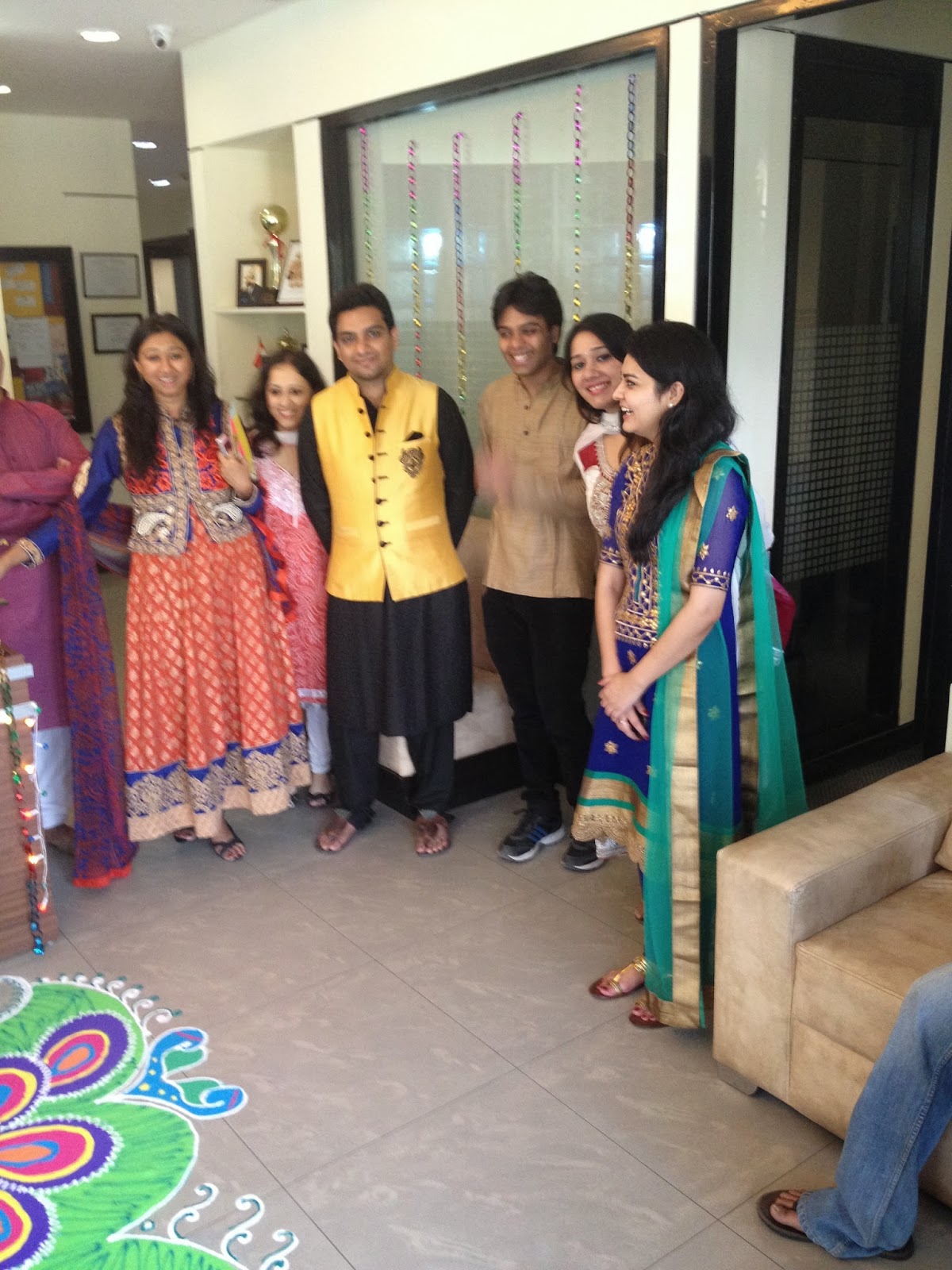
Friday we had our Diwali celebrations at work. There were several parts to the celebrations. First, everyone was supposed to wear traditional clothing and there was a winner for the one who was voted best dressed. Here are a few pictures of employees in the dress traditional to their part of India.


Next, different groups of employees participated in a rangoli contest, in which pictures were created on the floor of the campus. Rangoli typically consists of bright colored, decorative designs made in living rooms and courtyard floors during Hindu festivals. They are meant to be sacred welcoming areas for the Hindu deities. The ancient symbols have been passed down through the ages, from each generation to the next, keeping both the art form and the tradition alive. The patterns are typically created with materials including colored rice, dry flour, (colored) sand or even flower petals. Again, winners were selected for the best designs. Below are some pictures of the designs and their creation.


Unlike in the US where any hint of religious practice has to be scrubbed from holiday celebrations, a central part of our Diwali activities was a puja. All the employees who wanted to gathered in our auditorium where cushions had been spread out. As they sat two Hindu priests led our CEO, Charu Modi, through the sung prayers and offerings of the puja. Then towards the end of the ceremony, anyone who wanted to was included in symbolically making offerings to Ganesh and Lakshmi and receiving a cinnabar mark on their foreheads. In respect for the ceremony, I did not take any pictures of it, but here are a few of the set up and how the idols looked after the puja was completed.


After the puja Charu and I gave out presents to each of the employees. Some of the employees, then sat around and sang traditional songs and played games. We then had a joint lunch and most of the employees left early to start their individual or family celebrations. A few of us got to stay and keep the doors open and lights on.

I have been coming to India since 2002 and have been here many times. Over the course of my trips I have heard about Diwali (usually as in, well that’s Diwali so it would be better if you came a week or two later). However, I have never actually been here during one. It has been very interesting and I am glad we have been here to see and participate in it. The other iconic festival is Holi, festival of color. I moved here just after this year’s Holi. I am looking forward to participating in that festival next year.

Here’s Rae. Be gentle; she’s been sick this week.

While I was in the US, Phil said we had been asked to put on a US Halloween party for the branch.  I was able to grab a few items for our party here.  These items in the states wouldn’t have been considered very fantastic, but for people here, they were exciting.  I have come to realize that it doesn’t take much for people here to be impressed, grateful for your efforts, or excited.  I brought back some plastic skeleton rings, ghost napkins, plastic spiders, bats, skeletons, a plastic table cloth and some goodie bags with pumpkins on them. 

As Phil mentioned, I have had some kind of bug since I got back and so getting things prepared was an effort.  I made brownies and candied popcorn for part of the refreshments.  I made 120 brownies which was a bit of a task because all I have for baking is the toaster oven which is a challenge in and of itself.  If I put the rack on the lower setting then the bottom burns and one setting up burns the top, so the rack has to be moved half way thru the baking cycle.  I then made about 75 goodie bags of candied popcorn.  In any case, I got it accomplished and actually felt pretty good on Thursday for the party. Someone came up to me later to tell me how cute the bags were and that she was going to keep it as a souvenir of a great party. The treats were a hit. There wasn’t a crumb left of any of it.

Trying to figure out costumes here is a bit of a challenge as Halloween isn’t done here.  I had brought back some devil horns, a tail and a red feather boa.  I figured I’d go as a devil and Phil could be an angel, (which is typical of our relationship)(Phil - playing against part actually).  Who knew that between not feeling well and not being able to figure out which little store to go to for wire would make constructing angel wings so tricky?  I found 4 wire hangers and a white pillowcase and somehow created some angel wings.  I won’t try to describe the constructions process for the halo.  Like I said earlier, it doesn’t take much for people here to become excited and I had several people who asked if they could have the wings.  I had to explain that they were made from one of my pillowcases and so I needed them back. 

Unlike the US, finding bags of candy is a challenge, (forget big bags of mixed candy) and after checking several places we were able to find some individually wrapped candy that I would describe as equivalent to an individually wrapped life saver.  We had asked families to bring candy that they would pass out to the trick-or-treaters as they went from room to room in our building. Any of the candy that I saw the families bring was also similar to what we were able to find.  As Phil and I were talking afterward we were impressed with how excited the kids were for these little pieces of candy and how upset kids in the US would have been if that was what they were offered as treats.

We had a couple of activities for them to do.  One was a room where we strung string across (string is also a bit hard to find) and then different lengths of string hanging down from those with a piece of candy attached at the end.  The kids were blindfolded and with only theirs mouths tried to find a string and catch the candy at the end of it.  They were so excited to get their piece of candy.  We also had a fishing booth and the kids got a piece of candy and a skeleton ring, also something that really excited them.  I had a mother come to me at church to see if I had any extra rings because her daughter had taken hers off to wash her hands and left it at the church.  She was broken hearted and cried because she had lost her ring. Like I said, it doesn’t take much to thrill them.

Here are some things I am learning.  Things that we can easily get in the states, and take for granted, are not so easily gotten here.  Also, people here have so much less than we do and are so excited about things that we would turn our noses up at and be insulted by.  I’m realizing what a truly blessed life I have lived. 

We were so busy running the party that we failed to take any pictures.  If we can get someone to share theirs, and there were a lot of pictures being taken, then we will try to include them next week      

For now,


Namaste.

Sunday, October 27, 2013

Return, return to me, Don’t leave me here with nothing….

I’mm baaaccckkk!

This has been an interesting week if you consider that last Sunday I was in the US sitting in sacrament meeting watching 5 of my grandchildren participate in the primary program, and this Sunday I’m back in the branch in India.  Here are a few of the things I’ve experienced thru this week.

It is always hard to say goodbye to all my family and friends in the US, but it is equally hard to be away from Phil. Having said that I probably don’t need to tell you that this has been an emotional week.

Wednesday morning I began my journey back to India with my bags as full as they could possibly be.  My checked bag weighed in at 51 ½ lbs. and so after removing my robe it weighed in at exactly 50 lbs., Phew!  I had to take my robe out to Becca who was outside the terminal waiting in the car to see how strict they were going to be on weight.  I guess my robe will have to wait for the next trip to see if it makes the cut.  My carryon bag was actually heavier than my checked bag so when they offered to check it for free at the gate I took a few things out of it for the flight and checked it at that point.  So glad I didn’t have to lift it over my head into the overhead bins.

The total travel time is long and tiring with about 5 hrs. to Newark N.J. then about 5 ½ of lay over and then about 13 hrs. on to New Delhi.  By the time I got here I had a numb bum, a compressed spine and swollen ankles.  Oh, don’t forget that on international trips you need to be at the airport at least 2 hrs. early.  I think that makes about 26 hrs. of travel time after clearing customs and collecting bags.  I’m still trying to make the physical adjustment to all the time change.

I got home Thursday night and then meet a friend for lunch on Friday. We met at an area that I have not been to before.  Hauz Khas village is the name of the place and there are some ruins there which we took a bit of time to explore. It has become a shopping area that consists of designer boutiques, art galleries and restaurants.  I took a few pictures of the ruins but it was a hazy day so sorry they are not too clear.  This area was built by a Sultan in the 1200s and consisted of a water reservoir, a mosque, and a school.  It was interesting and I think Phil and I will need to go back for a more in depth visit.  Anyway, hope you find the pictures interesting.


Saturday Phil and I went to a Bazaar that is held for 10 days once a year and is put on by a bunch of artists and craftsman who come from all over and sell their goods.  The idea is that these artists can sell directly to the public and eliminate the middle man.  This allows them the chance to keep more of the profits for themselves.  It was clean (by Indian standards), and well organized, and a pleasant experience, especially since the weather has cooled off a bit.  We took a couple of pictures from the food court area.  You will notice our glamorous dining accommodations.  I was intrigued by the tiers of housing that surrounded the market and also the very large gates. 


I will end by describing a few of the other random sights I’ve seen thru the days since being back. Most of my sightings are of animals.  There have been the dogs and cattle, of course, but also, goats, donkeys, 4 young men riding pure white, slightly skinny horses down the road and, coming up behind a wooden cart carrying people.  The cart was bobbing up and down a lot and I was wondering what was causing that motion but when we got around it, it was being pulled by a galloping horse, not the usual slow paced oxen.  I think that is the first time I’ve seen a cart pulled by horses.  Oh, there was this little boy, probably 8-10 years old, with a black mustache painted on, who magically appeared in the middle of traffic to preform hand stands and demonstrate his double jointed shoulders by twisting his arms all the way around in one motion.  There are also all the usual people tapping on your windows asking for money and the vendors trying to sell you any number of things.

Well, that is an over view of my life in two different worlds this week.  Welcome back to India.

Phil’s turn…

And I for one am glad to have her back. As are all the members of the Branch who have been asking for a month when Sister Rae (or Sister Phil; they seem as confused about our names as I feel about theirs sometimes) will be back.

I thought I would add a little about construction here in India. This is on my mind because we are considering a new building for our main campus and I have been looking at sites. Major construction here is almost all reinforced concrete. They pour the vertical pillars, as you would expect, but what is really interesting are the floors and the walls between the pillars. The floors are what you would, at best, call a rough pour. They only make minimal effort to smooth out the surface. In fact am not really sure how they can float enough concrete, cement, or grout to make a flat, level, floor.

Next the walls. Between the reinforced concrete pillars they build a wall of red brick and then apply a concrete stucco coating on the interior and exterior walls. The walls are very poorly constructed with uneven runs of bricks with grout lines also of varying sizes of between an inch and two inches. There is no effort made to point the grout lines. Some grout spills over the bricks; some grout does not reach the edge of the bricks.  There are of course windows and, even in some new buildings, glass walls. However as I heard in my latest conversation with a contractor, they don’t often use triple or even double pane glass because it cost so much more and people rarely are willing to pay a premium for green construction. The pictures below give you some idea of what this construction looks like in process. Lest you think this is only one contractor, I have probably looked at buildings under construction by ten contractors since I have been here. All are the same.


One of the really interesting things is the construction crew live in the building whilst it is being constructed. As soon as the second floor is finished (serving as a roof for the first floor) they move in. They sleep on pallets or perhaps hammocks. They run a line to hang their clothes. They have little two burner gas stoves to cook their meals. They carry water in for their cooking, and as my father used to say, a sink bath is nearly as good as a shower. So rinsing off in a basin of water should be just fine. If you have read my previous blogs, you probably have a pretty good idea how they handle their, um “voiding” requirements. When visiting a construction site, there is more than one reason to watch where you step.

With that thought, have a good week.


Namaste.

Sunday, October 20, 2013

I will wait for you, Meditating how sweet life will be when you come back to me

.
The lyrics I have chosen for this week’s blog, from a song by Frank Sinatra, have a double meaning. The first layer meaning should be immediately obvious if you remember that Rae has been gone to the US for nearly a month and gets back this week. I miss her tremendously and do know how sweet life will be when she comes back to me. The second meaning will become clear as you read the blog and find out some of the events of this week.

Charu Modi, our founder, is a visionary. She is always looking for ways to push the boundaries of what we’ve done and what we can become. Part of her vision is to create a university that instructs and expands the whole person not just the intellect. She has a vision for an integrated curriculum/student life that would engage students intellectually, spiritually, physically, emotionally, and socially. To that end, we are always looking for ways to expand student experiences beyond the classroom. This week was an interesting experiment in that regard.

This week we have had Thomas Amelio on campus. Thomas is the Executive Director of the Open Center in New York City, which is dedicated to a holistic approach to developing and training people. They offer a wide variety of courses including meditation, yoga, massage, etc.. Thomas’ expertise, in addition to his management skills as the Executive Director, is in meditation. Born and raised in the States, he was trained as a boy by his father in yoga. Then as a young adult he came to India and spent many years studying in an Ashram (spiritual retreat) studying Hindu metaphysics and meditation. As I mentioned he has been on campus teaching seminars to our students, faculty, employees, and the general public on chakras, mantras, meditation, and healing. Part of the purpose was, as I said to expand the exposure of our students beyond the classroom and beyond the theories and concepts they are studying. Another aspect is to help us determine whether we should form a joint venture with the Open Center to offer a wide variety of courses to the public, such as they do.

I have participated in two of the seminars Thomas has taught. It’s been interesting on s couple of levels. I think I have mentioned before that about half of our student body are from countries other than India. So here we sat, an American teaching ancient Indian traditions to a group of people many of whom were hearing the concepts for the first time. Added to that mix were Indians for whom the ideas were at least basically understood and a significant number of whom were well informed about, and practitioners of, the concepts. This last group really struck me. What would Indians, who were trained in and practiced meditation techniques, think of this American coming in and teaching their traditions? Would they think, “What’s up with this gora (white person) in jeans and t-shirt coming here and teaching us? What does he think he is, some kind of guru?”

Well, if they did think that, they didn’t say so. I watched and most of the participants in his classes were quite engaged. Several came up to him after the sessions and visited with him one to one. Most tellingly, many of people came back for more than one session. In talking to some of them, they found Thomas’ western approach to the Hindu concepts direct and engaging compared to how a traditional guru would have taught the same concepts.

As for me, I found the sessions I attended fascinating. I had some basic understanding of chakras, mantras, and meditation. However, I never had studied these concepts in the detail I did this week. As I learned about the chakras and what they represent, I heard echoes of Jungian psychology and Maslow’s hierarchy of need. As I learned about the power of mantras, I reflected on the power that certain sounds (and music in particular) have in my own life. As I learned the concept that we are made of material bodies and “energy bodies”, I thought of my own belief that we are spiritual beings currently and temporarily inhabiting physical bodies. 

One clear difference in these beliefs, I know from my previous studies, is the belief of what is the ultimate outcome of the duality of physical and spiritual being. Hinduism teaches the ultimate state of man is to transcend the material and become one with the cosmic consciousness (a gross simplification I know). I believe, and the Church teaches, that our ultimate destiny is an eternal union of the spiritual and physical through the resurrection of Christ. Still, despite the differences in belief, there were ideas and concepts that resonated with me and which I was glad to learn and understand. In particular I felt closer to my sister Elizabeth whose beliefs are closely aligned with, perhaps even at one with, what Thomas taught. As I learned more about the belief that energy from our spiritual body can be used to influence and heal the spiritual bodies of others, I understood more fully how Elizabeth used those methods to bring comfort to our mom and dad in their last hours. Thank you, Elizabeth, for being a good, loving, caring person.

Church today was interesting. Last week we had a delayed broadcast of General Conference. This week was a recording of Asia Area Stake and District Conference. We started locally with announcements, opening song, and opening prayer. We then watched a recording from Salt Lake that included talks and presentations, from David F. Evans of the First Quorum of Seventy (he serve in my same mission just before me), Jean A. Stevens, First Counselor in the Primary General Presidency (and sister of our good friend Mary Griffiths), and Apostles Jeffrey R. Holland and Robert D. Hales. The meeting was very good, with a sweet strong spirit. Elder Holland, who has just been assigned to supervise the Asia Area noted that the Conference was being played in 24 countries, and in 17 languages. He noted the Church’s presence and influence in the Area was relatively new but the faith of those who join the Church, often in the face of significant societal pressure, is amazing.

After the broadcast, we had three baptisms. It is great to see the growth of the Church in India. It’s exciting to play a small part in that growth. Until next week I bid you…


Namaste.

Sunday, October 13, 2013

Festivals of light, Candles glowing oh so bright, Different people have different ways….


So, I’ll start by answering the question that probably has been keeping you awake at night: there was nothing wrong with the car. Yeah!

As the lyric title for the blog indicates, the theme for this week’s blog entry is festivals. I am going to start with the one currently being celebrated, write a little about Indian festivals from a macro level, and then end with some reflections on the “Mormon Festival” we just celebrated. So, put on your festival celebratory clothes, sit back, and enjoy.

As I write this blog, we are nearing the end of one of the most sacred festivals, at least in certain parts of India, Navaratri. Navaratri literally means nine nights (nava = nine and ratri = night) and this festival lasts over ten days and, yep you got it, nine nights. During Navaratri, the nine incarnations of the goddess Shakti or Devi (Devi is a Sanskrit word which is the root of our word divine) are worshipped. Shakti or Devi are two names for the same goddess. She is the embodiment of the feminine, creative aspect of the divinity. Hindus believe that without the feminine aspect the masculine aspect of the divine cannot achieve expression. Goddess worship in several different forms is a defining aspect of essentially all sects of Hinduism.

There are actually several Navaratri celebrated over the course of the year and in different parts of India. However THIS Navaratri is Sharad Navaratri (it takes place in Sharad, which corresponds with our September or October). It is the largest, most widely celebrated of the various Navaratri. Over the days and nights of the festival, celebrants fast, eating only one meal a day. Additionally, depending on the part of India there are certain foods that are eaten each day and some kinds of food that are strictly avoided. There are religious ceremonies conducted in temples and at shrines in individual homes each day. In some states there are colors assigned to the various day so that it is most auspicious to wear clothing of the color appropriate to each day of the celebration.

In the TV show Outsourced two expat Americans are discussing the perplexing number and names of Indian holidays and festivals. The employees of one of the two had told him that it was Vindaloo Day and that everyone got a half day off. Now Vindaloo is not a holiday; it’s a type of curry actually, but the ruse by the employees and the exchange by the two expats is emblematic of the difficulty I, at least, have had absorbing and understanding the cacophony of festivals and holidays. I have to say, trying to keep track of each of the holidays observed in India and the significance of each is daunting. In fact, I am well and truly daunted.

Like many things in India, there is no simple way to understand the topic of festivals. Or perhaps more accurately, if you try to simplify the explanation you will certainly be wrong. Let’s start with the number of religions. A friend of mine (yes Larry that was you) once asked if India wasn’t known as the land of 100 gods. Within Hinduism, a great number of Ishvaras, or personalized gods, are recognized and worshiped. Additionally there are also many murti and devas that are viewed as influencing human life.  Those recognized and the relative importance given to the various Ishvaras, murti, and devas depends on the Hindu sect.

Whilst Hinduism is nominally the religion of India (historically one of the names for India was Hindustan, which means country of the Hindus), India was the birthplace for four great religions: Hinduism, Jainism, Buddhism, and Sikhism. You add to the mix of Hindu sects about 14% of the population being Muslim (about 210 million people); about 3% being Christian (about 45 million people); about 2% being Sikh (about 30 million people); about 1% being Buddhist (about 15 million people) and things start getting interesting.

Now just to kick it up a notch, consider this. There are clearly divisions in Christianity, right? Lutherans see themselves as quite different from say Episcopalians. And while there are similarities in their beliefs, modes of worship, etc., there are marked differences. Additionally, how a Lutheran in, say Sweden, celebrates Easter or Christmas is likely to be quite different from how a Lutheran in Bavaria celebrates or how one in San Francisco would celebrate. Hinduism is even less monolithic, I believe, than Christianity. There are hundreds, probably thousands of sects within Hinduism each with its own gods, unique forms of worship, and celebration. Additionally, there are pronounced differences between which festivals or celebrations are significant from Indian state to state and how those observations actually take place. Now throw in a couple of hundred million Muslims, another 45 million Christians, 30 million Sikhs, and 15 million Buddhists, each with their own holidays, festivals, and traditions and you start to get a sense of the festival stew. In fact, I wouldn’t be surprised if there aren’t festival stews. With about a quarter of the world’s population and so many belief systems, SOMEBODY has to have a stew associate with a festival, don’t they?

From a business standpoint, trying to balance all of these celebrations and festivals to ensure you give time off to employees appropriately is really a challenge. There are secular holidays like Independence Day and Mahatma Gandhi’s birthday. Those are easy. Then where do you go? You can’t give everyone every festival off – no one would ever work. Yet religion is very important in India, so you can’t slight these festivals either. In some countries in Europe, the holidays you have are directly related to the religious preference you claim when you are hired. However, in India there is a great tradition (at least nominally) of respect and tolerance for different religions. As such there is some thought that segregating holidays exclusively on personal religious preference does not show the proper respect one should have for all religions.

What we’ve done at MAII, therefore, is to give everyone one religious holiday or festival off for each religion. So even if you are not, for instance, Christian you get Christmas Day as a holiday. Additionally, there are a certain number of religious holidays that are volitional. One can’t take them all off but one can chose which ones to take off within a set limit for the total days off. Kind of like a Chinese menu applied to religious holidays: one from column A, one from column B, etc.

I find the diversity of beliefs fascinating. I have always enjoyed studying and learning about different cultures. Often, at least historically, religious beliefs have a major influence on those cultural expressions. With formalized religious practice waning in much of the world, I guess one could say that is less the case now (not to get too controversial but I think traditional religions have just been replaced with the religion of secular humanism and now we are seeing the cultural manifestation of that). In any case, here in India the open expression of religious practices is still alive and well. I don’t know if I will totally absorb and understand it before we leave; probably not.

So now to the “Mormon Festival” to which I alluded earlier. I know many of the readers of the blog are members of the Church of Jesus Christ of Latter-day Saints but not all. So, let me give a little context. For the 183 years of its existence the Church (as we call it) has observed and I would say celebrated a General Conference twice a year:  in April and in October. During these two Semi-annual Conferences, believers from all over the world either assemble in Salt Lake or participate by TV or Internet in six Conference sessions for a total of twelve hours spread over two weekends each. (Well five of the six sessions happen on one weekend and one session happens the week before.) During these sessions, Church leaders give sermons and sacred music is performed by the Mormon Tabernacle Choir and other choirs. These “Conference Weekends” are considered sacred and special to most members of the Church. They are a time to get spiritually recharged, hear messages designed to help us deal with the trials and issues we face, and listen to beautiful and sacred music.

In India, given the differences in time zone, rather than stay up and watch Conference in the middle of the night, the sessions are recorded and then played the following week. So, while Conference Weekend was actually last weekend, we participated yesterday and today. Not to get too gushy, but I thought this Conference was amazing. Many of the talks were incredibly insightful and meaningful, at least to me. The selection and performance of the music was also wonderful. I found myself moved to tears on more than one occasion. There were several opportunities where I felt prompted to make commitments to improve my life and redouble my efforts to serve others and be a better disciple of Christ. It was a great weekend of renewal.

I had never thought of General Conference as festival before, but, I guess since I was thinking about festivals for this week’s blog, today it struck me that way. I do know that when a friend of mine, Mike Nowling, applied for a hospital administration residency with Intermountain Healthcare in Utah, one of the people with whom Mike interviewed said, “Now, Mike, since you are not a Mormon, I guess I should tell you about a religious event we have each October.” Mike said, “I’m not a Mormon but I know about General Conference.” The interviewer said, “No, I meant deer hunting season.”

I guess even in Utah there is a diversity of religious festivals.


Namaste.

Sunday, October 6, 2013

I struggle for this one, reach out for that, I take one step forward and two steps back

Okay, one step forward and two back is an exaggeration but I do feel in some ways this week has been one for one, leaving me about where I started the week. No, that’s only true in regards to living conditions; work (which is what actually led us here) is making real progress. First the stand still; then the progress. Actually, first an aside: I said, work led us here. Does that mean work is Spartacus? [If this makes NO sense, don’t feel bad. It is an obscure reference. I will be pleased if one or two pick it up. If you are curious, google, “I led you here for I am Spartacus.”] Really, I am not on anything; just a little dingy this evening.

Anyhoo, back to the stand still. Friday, I got a call that our car was done. I was gobsmacked. They had said it would be a week or so; I was sure it would be more “or so” than a week. I don't think anything has actually gotten done on time whilst we have been here. I thought there was no way we would get the car back prior to next week some time. No, they had it done in just a week. I was pretty excited. It has not been awful but having to rely on inconsistent, sporadic public transportation has complicated my life significantly. So, I was practically giddy yesterday and today, being able to come and go as I wished. Well, so much for that.

Traffic on the way home from Church today was about as bad as I’ve seen in Delhi, which is going some. All of a sudden, BAM. We were hit from behind. Mehndi got out of the car. The other driver got out of his car. They are both yelling at each other. I thought my presence would... what? I really don’t know, throw the balance in our direction? In any case I got out and went to the back of the car, and the arguing stopped for a minute. The other driver got into his car; Mehndi jumped in ours and cut his car off so he couldn’t move. So in the middle of an amazing traffic jam, we had our own little jam. About this time, one of New Delhi’s traffic police came strolling up.

Cop: “So, what seems to be the matter?”
Mehndi: “This guy ran into us”
Other guy: “No, this guy cut me off, that’s why I hit him.”
Mehndi: “He’s crazy. I was sitting here with my blinker on. He just ran into us.”
Cop: “OK, you both pull over there and we’ll sort this out.”

So SLOWLY we made our way across six lanes of traffic to a little covered shed this traffic cop and his supervisor were “working.” I don’t mean to disparage them or their work ethic, but as I noted the jam was as bad as any I had seen in and they had been doing nothing to try and resolve it. Anyway now our traffic cop and his supervisor both listened to the whole story again from the beginning. They stepped aside and talked with each other. They talked with the other guy. They talked with each other. They talked with us again. Half an hour later, they proposed a cash settlement between the other driver and us. They proposed he pay us 100 rupees (about $1.60!). I couldn’t believe it.

So, in the spirit of full disclosure, now that we were pulled to the side and I had time to look at the car more closely, it didn’t look like there was much more than some paint scraped off the bumper. However, the bumper did look like it might be dislocated about ¼ inch. I was worried there might be damage underneath the plastic and sheet metal. I certainly wasn’t going to agree to a settlement of $1.60!

So, we had another 20 minute conversation. The other guy got in his car and I was sure he was going to drive away. Nope, he went to get his insurance information. It seems, now this is pretty radical so try to follow this, the cop decided we should exchange insurance information and let them (and the court) figure it out. 

Mehndi thinks a little touch up paint and it’s all good. I tried to explain to him that I want the Honda dealership to check it out, just in case, you know, there actually is more damage than a little paint. I don’t have him convinced but fortunately it is not his call. So, if things go well, there will be a few hours down time; the car will check out; Mehndi can apply his touch up paint; badda bing, badda boom, we’re back on the road. However, if there is hidden structural damage, then I am back to public transport.

Putting that behind us, let me bring you up to speed on things at work. After five months we are finally starting to see some real progress. The matrices we use to measure performance are trending in the right direction. We are hitting or exceeding our goals. There is a noticeable difference in the attitude of the staff. Saying this is probably this kiss of death but I think we've turned the corner (that one's for you Larry Capps).

Thursday we had our Management Committee Meeting (essentially our Board of Directors). These used to be brutal. The interrogation we faced included everything but waterboarding. Now, as I look around the room I see smiling faces and heads nodding vertically instead of horizontally. I felt like the meeting was going well but that was confirmed by two things Mr Modi (Chairman of our parent group and one of the most insightful businessmen I have dealt with) said. 1) “I don’t see any reason we can’t start planning on opening two campuses a year”; and 2) “Things are clearly going better. I now have confidence we are headed in the right direction.”

So, I think I had it wrong. It really is two steps forward and one back. It’s not happening with lightning speed, but we are making progress.

Well, that’s it from India for this week. Check in next week to see if, or how long, our car is out of commission.


Namaste.